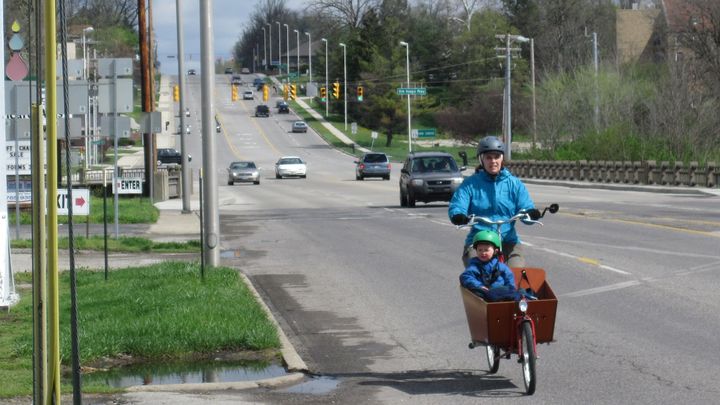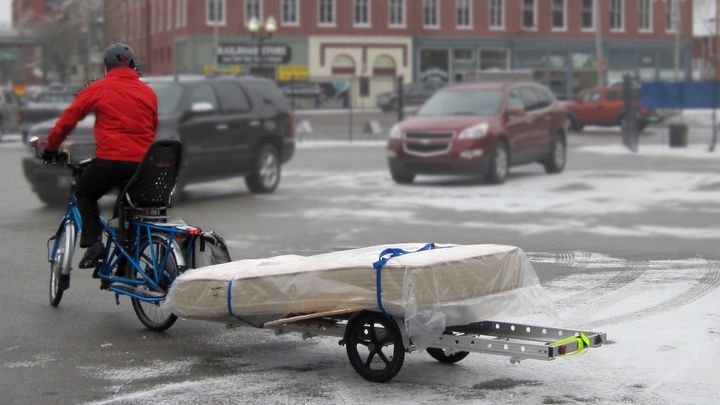
My own philosophy and recommendations would be rather similar. She also provides her own blog post with more details and photos.
You'll find several more tips on this site in the clothing category.
So I had this crazy idea to take a heavy, hundred pound bike on a 5 day, 220 mile bike trip through the rolling hills of Southeastern Indiana. To make the trip more interesting, my 18-month old, 30-pound daughter would ride in the bike I peddled, with my wife and retired father riding their own bikes along side us. My friend Kurt would also join us on a homemade recumbent bike he finished welding the night before departure.
We rode from Richmond, Indiana to Clifty Falls State Park over two days, camped and rested for a day, and rode back. Rather than journaling a day-by-day account of the trip, I’ve gathered some reflections on different aspects of the trip.
A significant deterrent to everyday bike riding is the prospect of getting chain grease on your clothing. European city bikes generally solve this problem with internal hub gears and partial or full or chainguards. The internal hub gearing also reduces the maintenance.
But here in the US, most bikes now have both front and rear derailleurs. And it’s just about impossible to find a chainguard that works in combination with derailleurs. But the new SKS Chainboard seems to be just that.
Read Patrick’s review of the SKS Chainboard on the Velocouture blog for a full review.
Here’s what’s new in the bike world as I see it from here in Richmond, Indiana.
Reid Hospital is having their first Reid Ride this year. It’s a 24 mile ride from the eastern border of Wayne County to the Eastern side. It’s $10 per peddler, and they ask that peddlers be at least 12 years old. Passengers under 12 years old are welcome in trailers, box bikes, etc. The ride starts at 7:30 AM on July 25th and mostly follows Route 40 across the county, after taking Main St through Richmond. There are checkpoints at 6 mile intervals if you don’t want do the whole thing.
The ride is billed as “Family Friendly” and the logo curiously shows a family on European commuting bikes, including light kits and fully enclosed chainguards.
Kurt Ritchie got his back-to-back tandem recumbent back on the road:
Although, the last time I saw the bike it was back in the shop to repair a weak weld in the steering column. I wish the Beast a speedy recovery and hope it see it more around town this summer.
Becky and Matt McKimmy bringing a little vélocouture to Richmond with their inspiring bike style:
For more inspirational bike culture, see these videos of Copenhagen as a Cycling City and Charleston Cycle Chic.
Earlier this year, we are discussing and help to shape updated bike laws for Indiana. The final bill, Senate Bill 553, did not pass. Bike Michiana has the details. Paul Taylor is already leading a renewed efforts for an updated proposal for 2010. Contact him if you’d like to collaborate directly on this.
You may recall our announcement of a Bicycle Safety class back in January. The project is currently in need of one or more volunteer instructors to move forward. I believe the Townsend Center is still interested to offer this, and we will have an excellent, easy-to-use curriculum to teach from.
If you are looking for a one-time volunteering opportunity, considering organizing a themed ride around town. This can involve as little as picking a time and place to start the ride from, and promoting the ride through Bike Richmond. I’d like to see a “Cycle Chic” ride like the Charleston Cycle Chic ride mentioned earlier. Or perhaps a dapper and dashing tweed ride would more your cup of tea, modelled after Tweed rides in San Francisco.
Every year a number of transcontinental cyclists come through Richmond. If you’d like to meet some of these adventurous souls, you can join Warm Showers, a mutual hospitality network for bicycle tourists. I recently met Evan Heidtmann (below) this way while Chris hosted a traveling band of bike polo players.
In this excellent three minute video, glimpse into the cycling culture of Copenhagen, a city that gets it right:
This week I lowered the gear on my bakfiets to prepare it for use on longer trips with steeper hills and bigger loads. It was shipped to me with a 17 tooth (17t) rear cog. Lowering the gear range involved purchasing and installing a 20t rear cog.
I found the 20 tooth cog online through Niagara Cycles, refered to as the “Shimano Nexus 20 tooth cog”. The product doesn’t seem to be listed on the site now. Perhaps it is temporarily out of stock. The part was about $6 plus shipping. My local bike shop charged me about $25 to install it for me, which seems like a good deal.
I was quite concerned that I wouldn’t like the change, that it would be too drastic. I had read online that people made this modification for “hilly areas”, almost as if there would be no good gears to use on level ground. My experience has been the change is no compromise at all. In fact, I think it would be sensible to sell them like this in the first place. On flat ground, I am more likely to be able to use the most efficient direct-drive gear. Before, the direct drive gear was set to high for my common use. The lower gearing is welcome on hills, allowing me to spin at a higher cadence. I doubt I’ll miss the lack of gears at the top end of the range. I rarely used them. As a cargo and kid bike, getting up to 20 mph sometimes is plenty, and the adjusted gearing still allows me to do that.
While I’ve only had a few days to test the new gearing, it already seems like a clear upgrade from the 17 tooth cog the bike shipped with.
Already this spring I’ve made a successful 20 mile trip with my 13 month old daughter, and she seems to love bike rides, even as long as that two hour trip. This summer I hope to try full day tours, with 50 or 60 mile distances. At this point, my primary concern is working out a shade solution for her.
Pranayama, or yogic breath control, taught me that breathing differently can make a big difference in how I feel. I applied an awareness of breathing to my car-free commuting and developed these two mindful breathing practices to increase my comfort walking and biking in the winter.
The basic breath I use is a heat conservation breath. It recognizes my primary heat source is myself. Maximizing warmth is accomplished by simply breathing in and out slowly through the nose. The nasal passage is a longer route than mouth breathing. A slower breath through the longer passage maximly warms the air before it reaches my core. A slow exhale means I’m holding on to the air I’ve just warmed up for a maximal amount of time.
A second technique, the breath mask, is an alternative to wearing a scarf or face mask. I breath in quickly through the nose then exhale slowly through my mouth aiming the warm air upwards. This creates a small cloud that warms my face. By breathing in quickly and exhaling slowly, I feel some heat on my face most of the time. The breath mask is ideal while walking into a headwind— the oncoming wind will blow the warm you’ve exhaled air back towards you.
Mindful breathing has made my winter walks more enjoyable. If you are looking to increase your own car-free commuting comfort, I recommend giving it a try.
Indiana currently has a significant bike bill under consideration, Senate
Bill 553. Bike Michiana, who helped draft the bill, has
a good summary. There’s also discussion
at Bike Richmond.
One of the many proposed changes in the law is a mandatory helmet law for those under 18 years of age.
Mandatory helmet laws are a point of controversy of cyclists, and many cycling organizations and cycling advocates, including myself, don’t support them. There are many well-documented reasons to not support a mandatory helmet law, backed up by research. Wikipedia has a good overview, and Bicycle Helmet Research Foundation has much to say against mandatory helmet laws, and the British Medical Journal has come out strongly against mandatory helmet laws.
A compelling proposal for mandatory helmets would at least address the major, well-documented reasons for not having such a law. Instead, this proposal offers only two weak justifications.
First, there’s the suggestion that we should make a law that is consistent with a minority of states. One could just as well argue that we should stay with the majority of states who don’t have such law. Then there was suggestion that would be good to be consistent with laws that apply to motorcycles, a vehicle that can travel much faster and thus more dangerous to operate. That’s like suggesting it would be a good idea to make motor vehicle safety laws that would be consistent with safety regulations of NASCAR drivers, who wear helmets inside their cars.
Helmets.org, a pro-helmet site publishes statistics about the number of fatal bike crashes that happen to kids to who would be affected by this law, during the hours which they may traveling two and from school. (Search on this page for Indiana). In that report they report zero fatalities for Indiana. That’s not the kind of crisis that sounds like we need new laws to address.
The reality here in Indiana is that beyond the general reasons for opposing mandatory helmet laws, we have other problems that complicate the alleged benefits. Most importantly, we have a lack of education among our cyclists, and among our drivers about cyclists. From what the Indiana Bicycle Coalition relayed to me fatal bicycle crash statistics in this area, a major contributor to these was not the lack of a helmet, but unsafe, and sometimes illegal, cycling which set the stage for the accident in the first place. Education can prevent accidents to happen at all, while a helmet cannot. Now on the one hand we lack bike safety education, on the other we lack enforcement of bike safety regulations.
A mandatory helmet law does nothing educate children about riding on the correct side of the road. And if our current bike laws aren’t being enforced, adding yet another just adds to the sense that the laws are meant to be followed, or are there to be enforced selectively against “bad kids”.
There are more effective ways for the Indiana government to support cycling and cycling safety, which I’ll cover separately.
As an experienced rider, a parent, and founder of Bike Richmond, I don’t support a mandatory helmet law. I find the rest of the proposed Indiana Senate Bill 553 to be a mixed bag. I’ll post more thoughts other details of the bill to Bike Richmond soon.
I’ve tried many things to warm my skinny fingers on winter bike commutes. Wool mittens with overmitts are best for the coldest days, but the most interesting heat source I’ve found is my diet. I’ve rediscovered what the Chinese learned ages ago when they classified food as warming and cooling. Science now understands that “warming foods” work in part through better circulation, stoking the internal furnace.
One winter I experimented focusing my diet on warming foods and spices. On my morning oatmeal, I add small amounts of cayenne, cinnamon and powdered ginger— each has its own warming properties. Cayenne in particular is great for improving circulation. At work I keep a shaker of cayenne to add lightly to my lunch and at dinner I may add red pepper flakes or hot sauce. Even small amounts will help. There’s no need to create painful levels of heat. I combined this with centering my winter diet on warming foods like potatoes, onion and garlic. I cut out cooling foods like cucumbers, lettuce and ice water. Now my hands now stay warmer, longer throughout the winter.
You may also rub a little cayenne directly on your fingers and toes before you go out for immediate additional warmth. Add more slowly— it’s possible actually use too much in a result in painful burning sensation.
One approach to bike advocacy is to believe that persuading the
the right people in government is the way to get things done.
Here in Richmond, Indiana, the issue is generally not getting the local government on board to support cycling, it’s that the city budget seems to be in an ongoing decline. There aren’t particularly funds for non-critical projects, and there may be less funds next year. It’s a tough time to launch any new government initiative that involves local tax dollars.
My approach to bike advocacy is to believe that a small group of committed citizens can create positive change. With strategy and creativity there’s plenty that can be done while the city budget is in decline.
Here’s a summary of what we’ve done here in Richmond, what’s planned, and what’s possible.
There's plenty of articles and statistics out there damning the practice of riding a bike on a sidewalk.
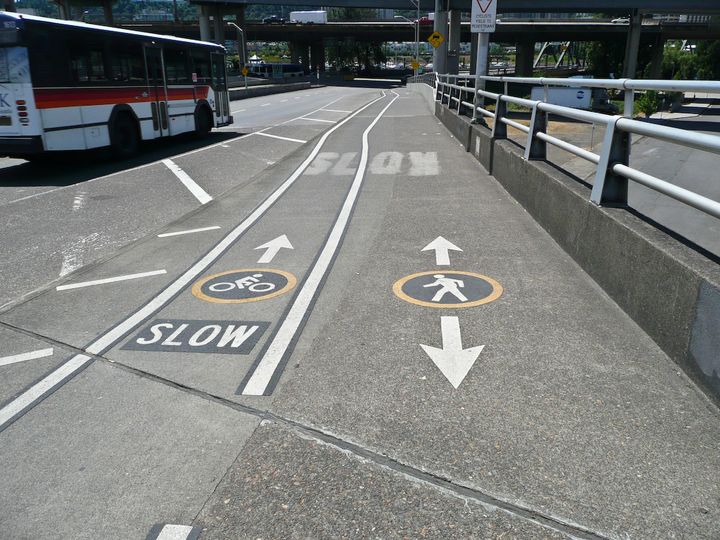
That's why I so surprised to come across what's seen in this photo from Portland, Oregon, the bike capital of the United States. On the Hawthorne bridge, bike traffic is directed on to the sidewalk.
As luck would have it, a Traffic Safety Specialist in Portland noticed I was posted bike photos of Portland on Flickr, and invited me out for a beer while I was visiting.
Greg Raisman was prepared to be questioned about that. He was aware of the same bikes-on-sidewalk-are-evil rhetoric. He explained this was technically a sidepath, and the important difference here is how the traffic is managed in the facility.
A sidewalk typically has many conflict points with motorized traffic-- driveways and intersections. Those are the places where accidents to tend to happen on sidewalks and are the source of the danger from riding bikes on them.
On Portland's Hawthorne bridge sidepath there are zero conflict points between bikes and cars. Cyclists roll up their own ramp to enter the facility from a bike lane. There are no roads or driveways to cross on the bridge while traveling westbound, and cyclists have their own exit ramp at the other end (rather than being dumped at an intersection). Meanwhile, the curb physically separates the bike traffic from the cars, providing extra safety and security compared to a painted stripe on the road.
I think the League of Illinois Bicyclists may have the right idea with their Sidepath Trail Calculator. Rather than being simply for or against bikes on sidepaths, they calculate a rating based a number of factors, such has how many driveway and road crossings there are along the path.
I still believe that there are many cases where riding a bike on sidewalk or sidepath could be more expensive for a city to support and more dangerous for bicyclists. Bridges generally don't have intersections in the middle of them and strike me as a place where a sidepath could be a safe and effective facility for bicyclists.
Greg Raisman was one of many gracious people I met in Portland, Oregon last week. He's a Traffic Safety Specialist for the City of Portland, and he gave me this tip for those interested in advocating for bike lanes in their own towns. | Road Element | Width |
|---|---|
| Standard through traffic lane | 11 feet |
| Standard parking lane | 8 feet |
| Standard bike lane | 5 feet |
| Standard center turn lane | 12 feet |
| Possible gutter | 1.5 feet |
| Possible buffer* | 3 feet |
On September 6th, 2008, Richmond, Indiana will have maps printed for a network of recommended bike route
map developed by experienced cyclists The city government endorsed and supported the project but was unable to fund it.
You can preview the front and back of the 17x22 map online.
Over the next several posts I'll detail how I led that effort. I hope that by sharing may experience in this project it may guide other motivated citizens who would like official bike routes in their towns, but don't want to wait until their cities have both the time and the money to produce them on their own.
If there's a quick summary to process, it's this: Anyone is welcome to design
and print a map, and it is experienced cyclists, not city bureaucrats, who are
most qualified to determine what recommended bike routes should be.
Complete table of contents: A Guide to DIY Bike Route Maps

Kurt made custom pouches for the custom longtail frame he built. The material used is what you usually find in fold-out couches-- super sturdy! The top of the rack is plywood. Here's he hauling two printers, a scanner, a keyboard and various other supplies.
Right now the two sides of the pouch are just tied together with string. He may upgrade those connectors with small caribiniers. The current design also lacks a frame to hold the pouches away from the wheels and derailler. It's working OK without them, but wil also likely be evolved.
If you are commuting by car right now for 5 miles or less, you can afford a bike to make the same trip on. The reality is that gas has gotten more expensive and the savings of riding a bike even for short trips adds up.
Let's look at some numbers.
The Supplement Scenario: Here we assume that a bike supplements a car that you plan to keep and drive, and that the savings of riding a bike will come purely from saved case. Using an online calculator, you can quickly estimate your annual fuel cost for a trip. If you travel 1.5 miles each way, 5 days a week, 50 weeks a year (you take some vacation, right?), that's 750 miles per year, spent on that short commute. If you get 20 miles per gallon and gas cost $4.00 gallon, then your cost of gas for that commute is $150 for one year. For five years that's $750.
Updated August 23rd, 2008. See corrected math and discussion in the comments.
I was recently asked: "How can get around town by bike without going up and down so many hills?"
Avoiding hills is often not an option, so I have to re-frame the question in order to answer it: "How I can be comfortable riding in hilly terrain?".
For a cyclist used to driving, there may be an adjustment about what to expect. A car may (unnaturally) travel the same speed up a hill, across the ridge line and back down it.
Bikes tend go much slower up hills and much faster down them. I've come to appreciate this. It's participation in the natural rhythm of gravity. It makes kicking back with cruise control and watching the world through a screen seem all the more eerie.
I recently returned with some friends and family from an unconventional vacation: riding bikes 110 miles over two days to Clifty Falls State Park, where we hiked and rested for a day...then rode back over two more days. Along with Kurt, Derrek, Hopi and Don we put together a bicycle tour journal with photos and stories featuring a home-built recumbent bike, wild parsnips, "road closed" adventures and more.
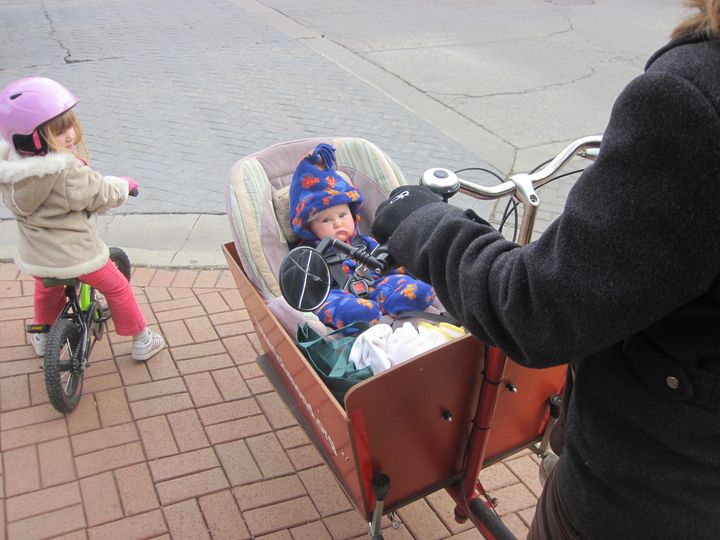
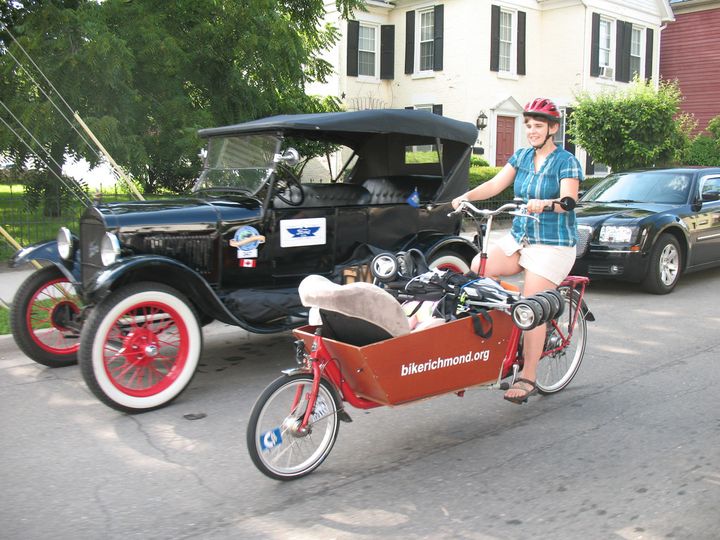
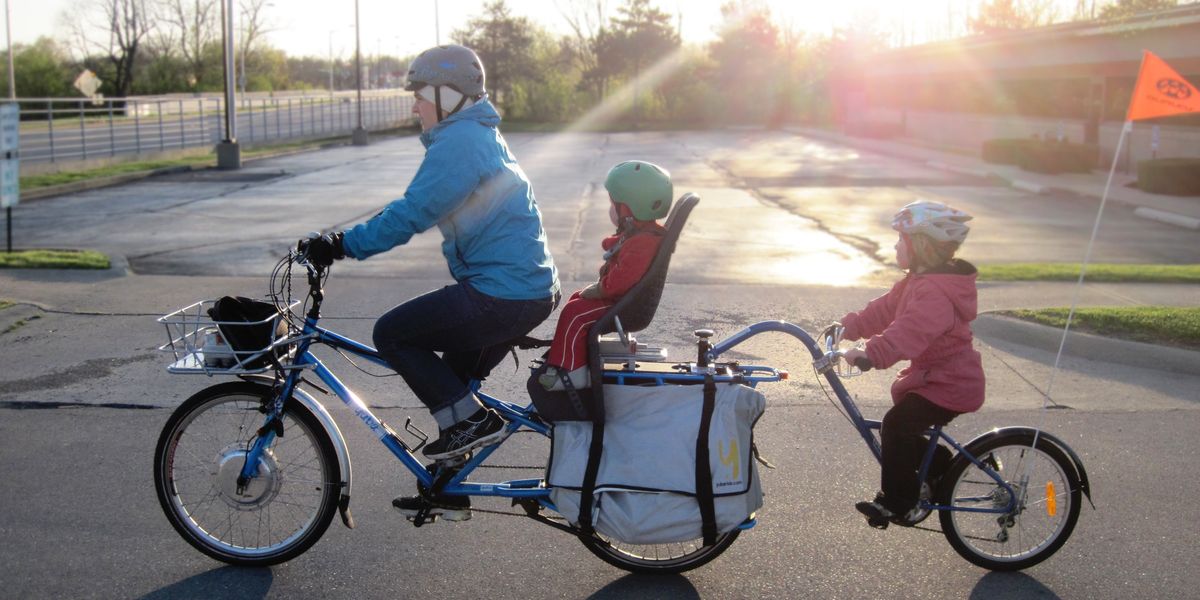
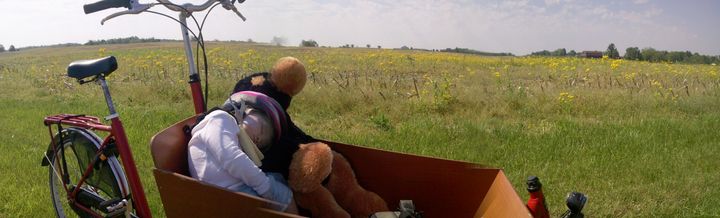
It's common that when someone sees our bakfiets they comment that "you could haul your groceries in that thing".
A first bicycle tour post-child. My wife assured me that bringing a
three-month old baby on a bike tour would work out fine. For me, taking
the trip was important for establishing that life does go on after
children arrive.
See the complete tour journal of our bicycle tour from Richmond, Indiana to
Clifty Falls State Park and back.
There's been increasing press lately about bicycling as transportation.
The difference between riding for recreation and transportation matters a great deal for the construction of the bikes, although few bikes focused directly on transportation are seen the US.
Here's a quiz of sorts to show how recreation vs. transportation attitudes lead to different bike designs. Follow along and see which style of bike matches you!
At the end if the quiz, there are some photos and details highlighting some features available on transportation bikes.
Today was our first Saturday with the bakfiets, and we kept the bike busy haulin' and transportin' from 8 am to 5 pm.
My wife took it first, riding it to Jazzercize and then to the farmer's market. She had trouble leaving with her cargo of sunflowers due to all the people asking about the cargo bike. Questions from strangers are common with the bakfiets.
Around 11am, I used the quick release to raise the seat from her riding position and started on the next trip. I loaded the bike up with over a 100 lbs of yard waste and headed to the local landfill to drop it off. Wrapping the garbage bags in a tarp kept the bucket extra clean.
Someone commented about my new bakfiets cargo bike this morning that "now I could I haul groceries on the bicycle".
I had been getting groceries fine on my "normal" bike fine for some years. But you couldn't tell that from casually looking the bike.
I never once made a trip where I couldn't bring home everything I wanted. Usually just some saddle bags were used for the hauling, but occasionally a trailer was used to fetch a large bag of dog food.
But on most trips the saddle bags and trailer are left at home, so the carrying capacity isn't visible.
The importance of the bakfiets in the US now is that it is obvious that the bakfiets is built to haul. And it does in fact haul a lot. I believe it's rated to haul about 250 lbs of cargo or kids, plus the weight of the driver. (That's 175 lbs in the bucket, and 75 more on the rear rack).
The name for bags that hang off the side of bikes seems to officially be "panniers" in English. "Panniers" is in-word in bike subculture that most United States folk don't know.
That makes it harder for me to talk about functional bicycling with folks. "Panniers" is a foreign word that makes carrying stuff on a bike sound, well, foreign.
Motorcyclists often call these "saddle bags". That's much more evocative. People generally know the words "saddle" and "bags". It's not a big leap to put them together and visualize what that looks like.
Cyclists who would normally refer to them as panniers would also readily understand "saddle bags", so there's not much of a need to use different terms for the subculture and the broader culture.
I want using a bike as transportation to seem normal. Easily comprehensible. So from now on, if you ask me about hauling stuff on my on bike, I'll tell you I have saddle bags. Like a motorcycle. Or a horse.

This was my first week-long self-designed tour. In the past I had added my own extensions to Cover Indiana and GABRAKY. Unfortunately, on both of these organized rides, I experienced some knee problems, and the fixed distances and schedules left me feeling locked into the event schedule.
By organizing my own trip, I had the flexibility to redesign the trip on the fly and use a more personally meaningful route-- riding from my home to visit family and friends in central Kentucky, about 150 miles away.
See the complete tour journal.Today I tried a cheap nylon jacket for rain protection. Like, "ten dollars" cheap. The jacket I wore is from Eastbay, and is discounted from $40 to $10
It kept me completely dry for a 10 minute bike commute through the pouring rain. Ten minutes is enough time for cotton clothing to get drenched. It's also enough time for me to get from home to grocery or from the office back home. It's enough time for a $150 Marmot Oracle rain jacket to begin to leak through the pockets.
That's precisely why I'm trying the backup jacket-- I'm sending in the Marmot jacket for what I believe is a design flaw and which I expect they'll take care of through the warranty process.
I was so surprised by the performance of the Eastbay jacket, I went online to check to see if it made any claims to be waterproofing. The jacket does not even classify itself as a rain jacket, but simply "water repellent".
From what I've learned about what "water repellent" means, a chemical was probably applied to the nylon, which causes the water to bead-up and roll off, rather than soaking through. Over time, this feature will work less and less well. They are spray-on solutions than can be applied to later to rejuvinate the effect, but from what I've read they often don't work as good as the original repellency.
This also means that had I taken a longer ride, I'm sure the jacket would have eventually soaked through, which a waterproof jacket should not do. Further, waterproof jackets have taped seams, and sometimes have special waterproof zippers, while this jacket does not.
What I'm saying is that the Eastbay jacket is not a magic alternative to the quality of a waterproof/breathable jacket. However, it may just be "good enough" for some around town trips, despite perhaps being less durable. At $10, or even $40, it's certainly worth a shot for staying comfortable in the rain.
My solutions for comfortable clothing and dry gear.
I was afraid of the rain. The car used to protect me from it when I got
around. After several years of being car-free, I've been able to replace this fear
with an understanding of how to stay comfortable when bike commuting in the rain.
What I've learned along the way that is the staying comfortable in the rain takes an all or nothing approach: Repel it or enjoy it.
Here are my strategies for both cases.
I recently wrote about Bicycling Mittens for Five Degrees. That's a solution for an extreme, so today I want to Back the Truck Up, and describe the gloves that I find work best for everyday bicycle commuting in cooler whether.
The qualities I find are important are:
Two years ago I was diagnosed with a herniated disc in my back. This caused my sciatic nerve to be pinched, which caused great pain in my legs when I was sitting or standing. I spent a lot of the next two weeks lying flat on my back. After standing for just a few minutes, the pain would become intense again, and I'd need to lie back down.
I'm the sort of person who resists taking medicine, and I found myself taking up to eight ibuprofen a day just to cut the pain and get through it.
Yes, having Sciatica sucked.
The cold wind pressed harder against me as the bike accelerated down Bridge Avenue. Despite the freezing wind chill, I remained comfortable behind my wind shield.
The key things I've learned about keeping my head warm on a bicycle are 1. The comfort of my face contributes a lot to my overall perceived comfort. 2. In cooler temperatures, blocking wind is the key to a comfortable face and 3. A lot of the wind I'm blocking is generated from pedaling itself.
I eased out the alley and navigated through Fairview neighborhood and onto the greenway. Accelerating as fast as I could down the light grade, the computer reported speeds accelerating to 20 miles per hour, with a air temperature of 32 degrees.
My new overmitts were being put to the test. According to a parka website, I had just generated an effective temperature of about 5 degrees Fahrenheit.
This hadn't fully clicked for me before: moving through space on a bike in cold weather generates significant wind chill.
With the sun rising in the distance, I found myself staring at a golden bicycle, abandoned by a dumpster. I'm not talking about a standard golden paint job. This was an all-over, no holds barred spray paint job. The seat was golden. The tires were golden. The water bottle cage was golden.
I stood there contemplating it, awestruck and contemplating it's story. Was this an Earlham "Community" bike, a re-habbed free ride, intentionally ugly to avoid theft? Perhaps it was stolen, painted gold to mask it's true identity. Or It could have been an art project. One last golden hurrah before the junk pile.
This post is available as an audio clip.
This is the story of why I traded in my car for a bicycle.
It's not that many people have asked about this. Rather I have sensed that people wonder about this unusual lifestyle choice and do not ask.
My story isn't going to be about lifestyle comparison or counting karma points. I want to convey the emotional parts of this transition.
I had some selfish reasons for wanting to get rid of my car. I don't particularly like driving them or riding in them. I don't know how to fix them if they break, and I'm not interested to learn. I didn't like car down payments, car insurance payments, car gas payments, car breakdown payments and car break-in payments.
"Let's Race!"
I challenged Ehren to a three mile crosstown race. I would ride my bicycle (as fast as I could!), and Ehren would drive his Volvo, taking a normal route and traveling average speeds in his car.
The destination was slightly uphill from us.
"Go!"
Soon the routes we chose to follow diverged, and I didn't see Ehren until the destination.
He pulled in about 30 seconds after me, complaining about traffic.

I banked my bicycle towards the sign labeled "International Circus Hall of Fame". On the outskirts of Peru, Indiana Hopi and I pedaled down the rural road looking for something that would live up to the name on the sign.
I thought we were close when we passed what appeared to be flying trapeze rigging sitting in a field in front of two large barns. Still, nothing looked active or open.
I paused in front of a plain trailer with a small window labeled
"TICKETS" on one end. As a dog barked nearby, I was working up the
courage to knock on the door of what increasingly appeared might be the
wrong building.
Read the complete tour journal.
It was immediately clear when they arrived tonight that they looked fairly normal and fit very well, but the hidden super powers needed to be tested. Conveniently, the kitchen floor needed mopping as well.
By the 40-mile morning rest stop in Willisburg, I was about ready to give up again, and my bike was making a strange creaking noise at times. Scott, our ever-present mechanic from Pedal Power was there to help. Meanwhile, I snacked on Clif Bars and Advil and rested.
A small screw on my brakes was stripped he said, and he didn't have the part to replace it with him. This was necessary to hold my back break on.
I ate a banana, drank some water, and let him tinker some more, half hoping a mechanical failure would be my excuse for not completing the day. Already, all but the slowest two riders had come and gone from the rest stop.
But dropping out was not my fate. A few minutes later Scott had jammed a wire cap perfectly into the stripped hole, and promised a full brake kit replacement that evening. He just happened to have parts for the exact model in stock.
So I was back on the road again now with no riders in sight ahead or behind me.
At least one hill was too much for my knee before I got to the lunch stop. I got off and walked the bike up it.
Read the complete tour journal.
Early May, 2005
I got several positive looks and comments as I pulled my full loaded recumbent bicycle out of town.
With the trailer and bright yellow pannier covers, it was hard to miss.
"What did you pay for that?"
"What IS that?"
"NICE BIKE!"
Along the route, I got the opportunity to try out a loose dog defense technique I'd read about. I squirted the barking booger in the face with my water bottle when he got close enough. The dog did in fact stop immediately, as confused as anything else.
I wanted to follow the pattern of Rans V-Rex
Commuting Weapon by adding an additional water bottle mount to carry a
light system battery.
That's what the picture above is. There's also a large version. Here are some notes on how this was created.
After spending hours poring over Arkel's website, I've just purchased my third Utility Basket bag from them.
Today I'll share some of the hidden features of the 2005 Utility Basket which make it suitable for touring as well as day-to-day commutes.
Today was the first real test of my new Rans V-Rex 'bent. After a week of
waiting, the new derailleur was finally installed. I planned a twenty mile solo
trip to Whitewater, Indiana and back. Out on my own, I was going to find out
how the new bike compared to my old one longer trips.
One part was no surprise. As a recumbent, it was definitely a more comfortable ride. The only part of me that was a little sore coming home was my legs.
The ride to Whitewater was a little disappointing. I just wasn't keeping the speeds that I wanted to. The terrain was some of my favorite-- the rural gently rolling hills of Indiana, with peaks and valleys that are often only 10 or 20 feet apart in height.
I did notice suspiciously that each new peak seemed a little higher than the last. When I arrivied at Whitewater, my average speed was lower that I would have liked: about 14 mph.
I had not been to 'downtown' Whitewater before that I recall. As I ride through each of the small towns around Richmond, I have almost always discovered a new General Store or cafe that I hadn't noticed before.
Recent Comments