August 2008 Archives

Depot District Once the map design was substantially complete, I was invited back to meet with the city for a final presentation to the mayor and key department heads (Police, Parks, Streets, Metropolitan Development).

The agenda at this meeting included final approval, funding, signage and next steps.

I again emphasized that this work was supporting the Comprehensive Plan and showed another short slide show to present a positive vision of bike culture. I also went over all the valuable information the back up the map. There was support for the project, but not funding-- budgets were already being cut all throughout the city. The idea of signing the routes was also supported, but lack of funds meant that would have to wait as well.

In talking about next steps, I boldly presented to the mayor a new job description-- for the new bike/ped coordinator we need! (See the job description as a PDF, edit it as RTF). I emphasized that simply if the idea of having this position was desired, it might be possible to create it through a grant, as an internship or with a volunteer. With the cost of gas likely to continue to climb over time, it seems strategic for city's to invest in something which can improve quality of life, quality of the air, health and transportation. I haven't heard anything back about this, but I like to think a seed was planted.

With all my content gathered, I sought out the services of a professional graphic designer to put it all together and work with the printer. I failed at finding a volunteer for this, but ended up enjoying taking on this role myself. Although I hadn't done print design in a long time, I had studied it in the past and had experience designing books and newspapers.

While I won't go into detail about the graphic design process, I can tell you that I used exclusively free, open source software to complete the job, and felt efficient using these tools. The software involved included:

  • Ubuntu Linux (operating system)
  • Inkscape, for processing source SVG vector graphics from Calgary
  • GraphicsMagick, to convert PDFs from the GIS office into hi-res PNG images
  • Gimp, for photo processing and adding drop shadows
  • Scribus, for layout

About the only especially technical thing I had to keep in mind was to try to use images that were 300 DPI or larger. I used one 150 DPI image anyway, and was still still satisfied with the result. Scribus took care of automatically converting the images to use the CMYK color space and output a high quality PDF, which the printing service was able to translate perfectly. The printing service doesn't need to have Scribus. Indeed, they have never even asked which software produced the PDF I gave them.

For the front side of the map-- the side that actually has the large map on it, our local City/County GIS department produced the map image and legend for the project at no charge. They were essentially tracing the map we created and it sounded like it wasn't very hard for them. It helped that our contact there walked to work regularly and believed in the project.

If the city had not cooperated in this way, I would hope that we could get a basic map of the city of through an "open records request", and then overlay the routes ourselves, if necessary.

Some more details I included on the map:

  • A photo and description of getting the bikes on and off the buses which had just gotten racks. I had this part approved by the local bus organization. They were excited about the project because they considered both bikes and buses to be alternative transportation, which could strengthen each other.
  • A disclaimer of the City's liability for the use of the map. I'm sure how much it's worth legally, but it didn't take up much space and I thought might improve the chance of approval. You can see an example disclaimer I found.
  • A non-official city logo. If the city would pay for the maps, I would swap in their official logo, but that didn't happen.  Jim Hair let me use the great Richmond logo that he uses for his own promotion of Richmond.

For the final presentation of the proposed network, I got a full size map of the city-- the kind available to tourists. I carefully went over the recommended routes with a yellow highlighter.

At this point, there was surprisingly little discussion about the network, and relatively easy approval. And when there were questions, I was prepared to talk in detail about every segment-- how wide the road was, how much traffic it had, and why experienced riders had suggested including or excluding it.

We now asked for official approval of the network itself in an abstract sense. Doing this required no commitment by the city to produce a map, put up signs or really do anything at all. We were simply asking them back up the group of experienced of cyclists with endorsing our work as an "official recommended network". The Mayor approved it. 

Rainy day gorge tour Using the newly form bikerichmond.org group, we had multiple meetings where we would ride part of the routes together as a group, and then review the current draft map and discuss it.

The group review process was very valuable. Other riders suggests routes I wasn't aware of, cited reasons to avoid some of the routes I had recommended, and suggested useful tweaks as well. ("If you just move this segment one block over, it will go right by the museum").

Every time changes were made, I would post a new draft to the mailing list, listing out all the changes and why we made them. The process repeated until the list was quiet with refinements. Some rules of thumb we developed:

  • If in doubt, leave it off. Getting the map produced at all is more important including any particular segment. Any controversial segment may or may not be a real safety issue, but the controversy itself could hold of the approval process.
  • It's OK if there are gaps in the maps. You'll see them in the Albuquerque map. These represent areas that need infrastructure improvements to be recommendable. The gaps on the map become a great advocacy tool. "The map clearly illustrates three key problem spots for bike commuting. See here? We could really use a bike lane to get past the old Reid Hospital"

Our community needs a lot more than a bike map. We need a large dose of bike education. While the map itself would take up one side of the document, there is some freedom with what can go on the back of map.

I wanted this map content to be the best possible. First, I collected as many bike maps as I could. I contacted the Indiana Bicycle Coalition, the Indiana Department of Transportation and the Indiana Department of Natural Resources to find out which other cities in the state already had bike maps, and how I might get a hold of their maps. All of these organizations were helpful in supplying either consulting, maps or references for further contacts.

However, it was by luck that local cyclist Jane Holman gave the best map I've seen: from Albuquerque, New Mexico. Our map design and content is based most closely on theirs. It includes several sections of information:

  • Local bicycle laws
  • Local bicycle photos
  • Local bicycle shops
  • How to get a bike on and off a bus rack
  • Biking to Work
  • Infographics, to illustrate key safety points
  • Considerations for Moms and Dad

The "local" portions were easy enough to take care of. (I copied the local bike laws off the city website), and local photographer Jane Holman contributed some photos.

That left three sections of the Albuquerque map that I wanted to model. I was able to get explicit permission in each case to re-use the content directly. The safety graphics were credited to Calgary, Canada and by contacting Ken Richardson there, I was given high quality source files of the same graphics to use for this project.

The "Moms and Dads" text was traced to Kalkomey Enterprises, and I successfully contacted Kurt Kalkomey and received permission to re-use this text as well. The "Biking to Work" text actually originated in Albuquerque, and James Arrowsmith there gave me permission to re-use that.

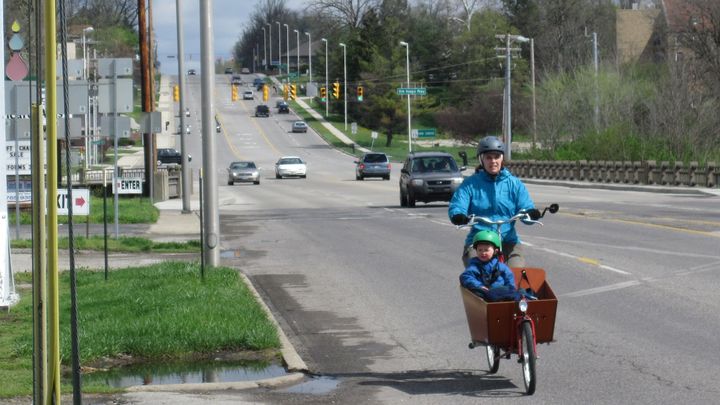
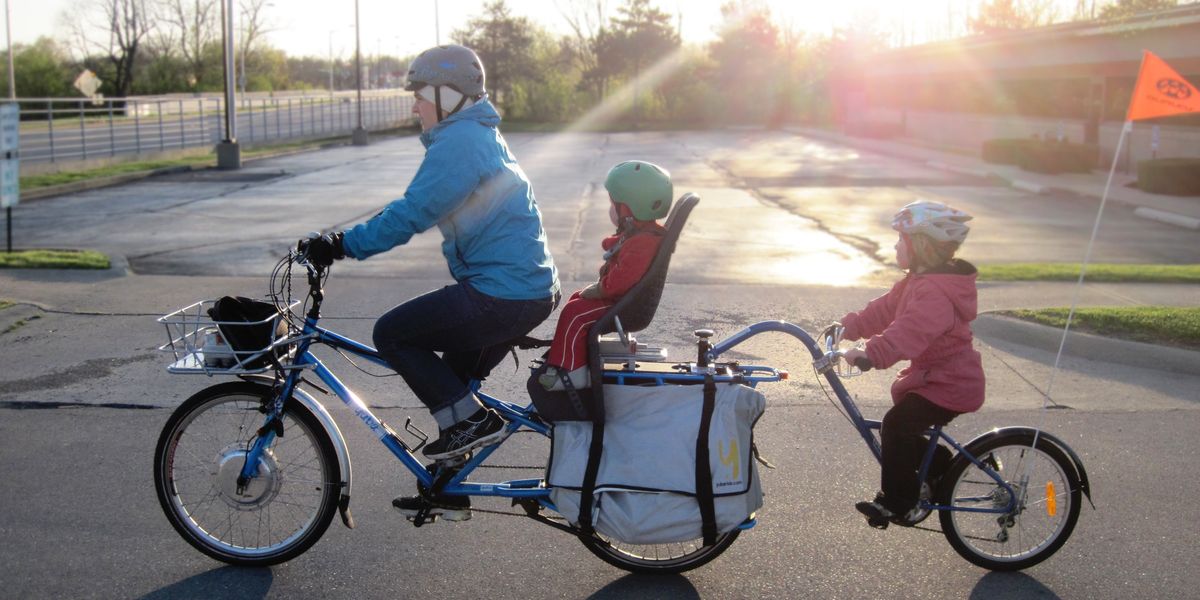
I really wanted to use the photos to show different ways of cycling-- something besides mountain bikes, road bikes and spandex. One photo is of a recumbent bike. (Actually, it's me...) I also really wanted a photo of a XtraCycle being used as a family bike. No one in town had one at the time, but I think they may be a great antidote to cargo and kid hauling in the face high gas prices, once people discover them. So I got permission to re-use a photo from carfreedays.com of a mother riding a child to school in light snow.

Through a contact in the "Metropolitan Development Department" I got an audience with a "Transportation Committee" which was tasked to implementing the transportation related aspects of the City's Comprehensive Plan. The Plan among other things directs the city to complete a network for "motorized and non-motorized transportation".

Given that, I pitched my project has helping the City to meet it's own stated objectives.

I also understood that getting support from the City meant more than just showing off map and getting a thumbs up.

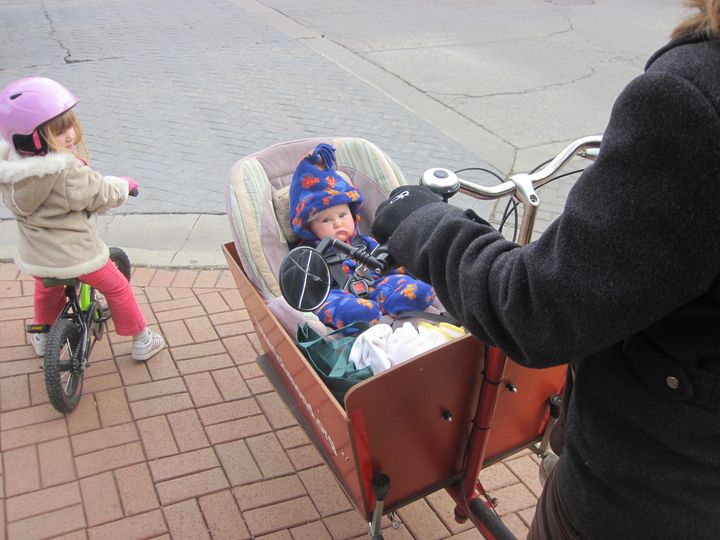
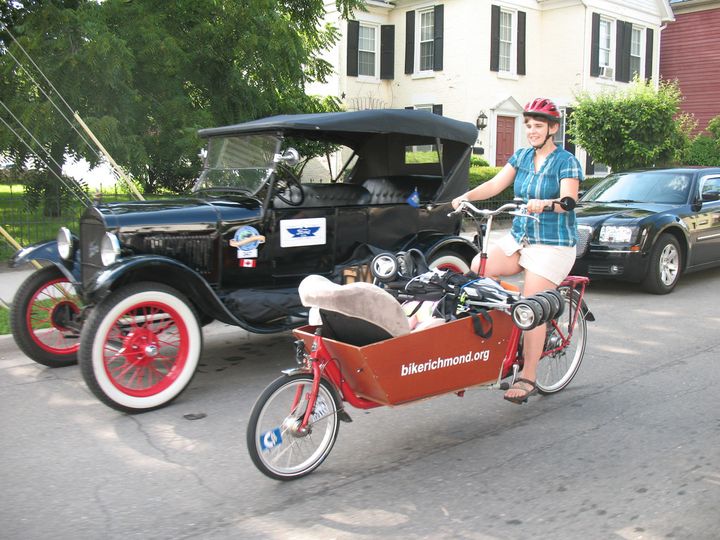
I spent most of my 10 minutes with the mic to brief the group on a vision of a bike-friendly community. I used a photo-heavy slideshow with background music to show off XtraCycles, Bakfiets, velomobiles and sensible european commuting bike fashion. I think this actually worked to get the group more exciting about bicycles. Having set the mood, I used the last few minutes to show of the draft of the map. I was invited to present a final draft to the Transportation Committee for their approval, who could in turn recommend the network for approval by the Mayor.

I also came prepared with a lot of bicycle safety statistics in my back pocket. Not wanting to frame the conversation around safety, I didn't bring up the topic much, but I was well-prepared to discuss the reality of cycling safety if someone else brought it up.

kurt on his homemade high-racerGoogle's My Maps feature came out just about the time the project started, and I used a similar tool to prepare the first draft of recommend bike routes. At the time, there wasn't the feature for multiple people to edit the same map, but they've since added that feature to Google MyMaps.  I recommend Google's My Maps for collaboratively creating and sharing drafts of bike routes.

"My Maps" also offers the feature to add photos to the map. So, if someone has a question about a particular stretch of road, they can click on the photo and see an example of it, assuming I had taken a photo there and uploaded it. The need for using that feature has somewhat been eclipsed by Google StreetView where it is available.

After getting some feedback from other riders, I was prepared to initially present the idea to the City to get the city's initial response to the concept. At this point, my question for the city would be: "If I worked with experienced cyclists to develop a final draft of recommended bike routes, would the City consider approving the network as an official network of recommended bike routes?".  I was clear that the simply approving the network could be the first phase of the project. Working out funding for maps and signs could come later. By separating out the funding issues, our cash-strapped city would have an easier time approving the project.

A person representing a group is more likely to get the attention of the city than person speaking out of their own personal interest. That was one motivition to start "Bike Richmond". I also wanted to provide a transportation focus to compliment an existing bike group in town which focused on recreational riding. Involving other experienced cyclists would also provide great feedback on a bike routes, and set the foundation for organizing events.

However, I didn't want the overhead of setting up a real non-profit legal entity, having a board of directors or regular monthly meetings. Instead, I created a free Google Group and bought the bikerichmond.org domain and redirected it the google group. The domain costs about $15/year, and a Google Group takes just a few minutes to set up. 

Since Google Groups provides a membership count for the group, we had an official group count that I could refer to, and I could generally then say that I now represented "Bike Richmond". Many details were discussed on the list and we generally closed with a consensus about direction.

To further help make the lightweight organization "official", I designed a simple business card for the organization (download the compressed PDF) using the free gLabels program Since it just mentioned the website address without a specific name on them, any group member was able to take some and distribute them if they'd like.

The simple promotion helped get the name out and grow the organization.

bakfiets: one year in On September 6th, 2008, Richmond, Indiana will have maps printed for a network of recommended bike route map developed by experienced cyclists The city government endorsed and supported  the project but was unable to fund it.

You can preview the front and back of the 17x22 map online.

Over the next several posts I'll detail how I led that effort. I hope that by sharing may experience in this project it may guide other motivated citizens who would like official bike routes in their towns, but don't want to wait until their cities have both the time and the money to produce them on their own.

If there's a quick summary to process, it's this: Anyone is welcome to design and print a map, and it is experienced cyclists, not city bureaucrats, who are most qualified to determine what recommended bike routes should be.

Complete table of contents: A Guide to DIY Bike Route Maps

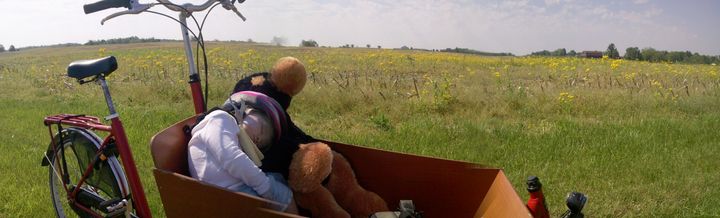
Bakfiets in woods

While "quick trips to the store" can feel they are sucking my life away, completing the task this morning by bike was fun.

longtail bike at work

| No Comments

longtail bike at work, originally uploaded by Mark Stosberg.

Kurt made custom pouches for the custom longtail frame he built. The material used is what you usually find in fold-out couches-- super sturdy! The top of the rack is plywood. Here's he hauling two printers, a scanner, a keyboard and various other supplies.

Right now the two sides of the pouch are just tied together with string. He may upgrade those connectors with small caribiniers. The current design also lacks a frame to hold the pouches away from the wheels and derailler. It's working OK without them, but wil also likely be evolved.

recent bike photos

www.flickr.com
Powered by Movable Type 4.21-en

About this Archive

This page is an archive of entries from August 2008 listed from newest to oldest.

July 2008 is the previous archive.

September 2008 is the next archive.

Find recent content on the main index or look in the archives to find all content.