October 2008 Archives

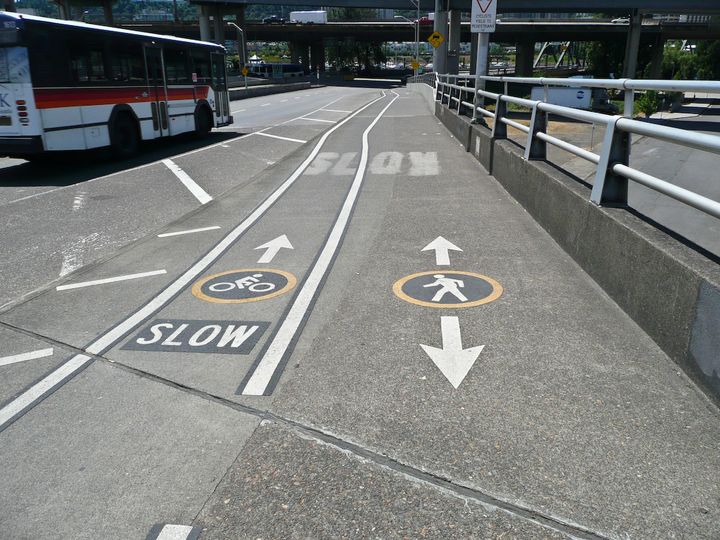
sidepath on Hawthorne bridge in Portland, Oregon There's plenty of articles and statistics out there damning the practice of riding a bike on a sidewalk.

That's why I so surprised to come across what's seen in this photo from Portland, Oregon, the bike capital of the United States.  On the Hawthorne bridge, bike traffic is directed on to the sidewalk.

As luck would have it, a Traffic Safety Specialist  in Portland noticed I was posted bike photos of Portland on Flickr, and invited me out for a beer while I was visiting.

Greg Raisman was prepared to be questioned about that. He was aware of the same bikes-on-sidewalk-are-evil rhetoric. He explained this was technically a sidepath, and the important difference here is how the traffic is managed in the facility.

A sidewalk typically has many conflict points with motorized traffic-- driveways and intersections. Those are the places where accidents to tend to happen on sidewalks and are the source of the danger from riding bikes on them.

On Portland's Hawthorne bridge sidepath there are zero conflict points between bikes and cars. Cyclists roll up their own ramp to enter the facility from a bike lane. There are no roads or driveways to cross on the bridge while traveling westbound, and cyclists have their own exit ramp at the other end (rather than being dumped at an intersection). Meanwhile, the curb physically separates the bike traffic from the cars, providing extra  safety and security compared to a painted stripe on the road.

I think the League of Illinois Bicyclists may have the right idea with their Sidepath Trail Calculator.  Rather than being simply for or against bikes on sidepaths, they calculate a rating based a number of factors, such has how many driveway and road crossings there are along the path.

I still believe that there are many cases where riding a bike on sidewalk or sidepath could be more expensive for a city to support and more dangerous for bicyclists.  Bridges generally don't have intersections in the middle of them and strike me as a place where a sidepath could be a safe and effective facility for bicyclists.

marking lanes for shared bike / walk sidewalk Greg Raisman was one of many gracious people I met in Portland, Oregon last week. He's a Traffic Safety Specialist for the City of Portland, and he gave me this tip for those interested in advocating for bike lanes in their own towns.

There are likely roads in your own community that you suspect are already wide enough to accommodate a bike lane-- They just need stripes to mark the lane. You can check road widths yourself by using a measuring wheel, found for about $10 on E-bay.  A measuring wheel measures distances as you walk. To measure the road width, you just have to walk across the road while rolling the wheel.  Keep in mind these details and do the math to determine if you've already got room for bike lanes:

Road Element Width
Standard through traffic lane 11 feet
Standard parking lane 8 feet
Standard bike lane 5 feet
Standard center turn lane 12 feet
Possible gutter 1.5 feet
Possible buffer* 3 feet
* The possible buffer zone is between parked cars and the bike lane, to prevent "dooring" and allow for possible snow piles in winter.

There are cases where narrower minimum lane widths for all cases may be acceptable. Check the federal standards for details.

Armed with these calculations, you can make a much stronger argument to City Hall if you can show definitively that no costly road width expansion will be needed, and you can say with certainty that bike lanes will fit.

But you may also  find that there is in fact no room to simply stripe a bike lane on roads you check. There are still possibilities to make roads more bikeable by using a road diet or the bike boulevard concepts. I expect to write more about these in future posts.

I ordered my measuring wheel tonight. I'll be interested to see what I learn about my city streets!

recent bike photos

www.flickr.com
Powered by Movable Type 4.21-en

About this Archive

This page is an archive of entries from October 2008 listed from newest to oldest.

September 2008 is the previous archive.

November 2008 is the next archive.

Find recent content on the main index or look in the archives to find all content.