January 2009 Archives

garden harvest by bike Indiana currently has a significant bike bill under consideration, Senate Bill 553. Bike Michiana, who helped draft the bill, has a good summary. There’s also discussion at Bike Richmond.

One of the many proposed changes in the law is a mandatory helmet law for those under 18 years of age.

Mandatory helmet laws are a point of controversy of cyclists, and many cycling organizations and cycling advocates, including myself, don’t support them. There are many well-documented reasons to not support a mandatory helmet law, backed up by research. Wikipedia has a good overview, and Bicycle Helmet Research Foundation has much to say against mandatory helmet laws, and the British Medical Journal has come out strongly against mandatory helmet laws.

A compelling proposal for mandatory helmets would at least address the major, well-documented reasons for not having such a law. Instead, this proposal offers only two weak justifications.

First, there’s the suggestion that we should make a law that is consistent with a minority of states. One could just as well argue that we should stay with the majority of states who don’t have such law. Then there was suggestion that would be good to be consistent with laws that apply to motorcycles, a vehicle that can travel much faster and thus more dangerous to operate. That’s like suggesting it would be a good idea to make motor vehicle safety laws that would be consistent with safety regulations of NASCAR drivers, who wear helmets inside their cars.

Helmets.org, a pro-helmet site publishes statistics about the number of fatal bike crashes that happen to kids to who would be affected by this law, during the hours which they may traveling two and from school. (Search on this page for Indiana). In that report they report zero fatalities for Indiana. That’s not the kind of crisis that sounds like we need new laws to address.

The reality here in Indiana is that beyond the general reasons for opposing mandatory helmet laws, we have other problems that complicate the alleged benefits. Most importantly, we have a lack of education among our cyclists, and among our drivers about cyclists. From what the Indiana Bicycle Coalition relayed to me fatal bicycle crash statistics in this area, a major contributor to these was not the lack of a helmet, but unsafe, and sometimes illegal, cycling which set the stage for the accident in the first place. Education can prevent accidents to happen at all, while a helmet cannot. Now on the one hand we lack bike safety education, on the other we lack enforcement of bike safety regulations.

A mandatory helmet law does nothing educate children about riding on the correct side of the road. And if our current bike laws aren’t being enforced, adding yet another just adds to the sense that the laws are meant to be followed, or are there to be enforced selectively against “bad kids”.

There are more effective ways for the Indiana government to support cycling and cycling safety, which I’ll cover separately.

As an experienced rider, a parent, and founder of Bike Richmond, I don’t support a mandatory helmet law. I find the rest of the proposed Indiana Senate Bill 553 to be a mixed bag. I’ll post more thoughts other details of the bill to Bike Richmond soon.

Cayenne for Winter Warmth

| 1 Comment

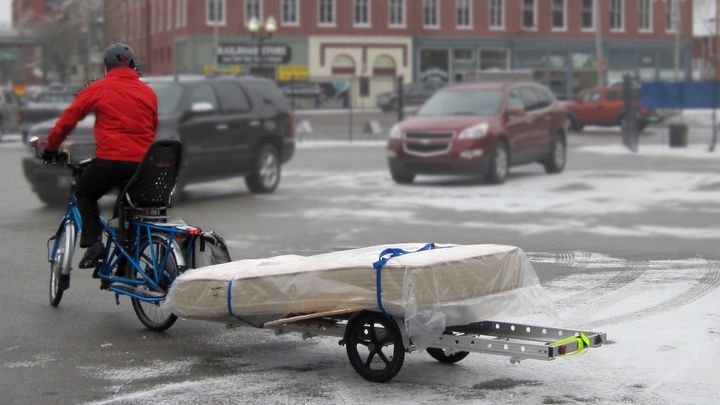
Biking to church at 0 degrees Farenheit. I’ve tried many things to warm my skinny fingers on winter bike commutes. Wool mittens with overmitts are best for the coldest days, but the most interesting heat source I’ve found is my diet. I’ve rediscovered what the Chinese learned ages ago when they classified food as warming and cooling. Science now understands that “warming foods” work in part through better circulation, stoking the internal furnace.

One winter I experimented focusing my diet on warming foods and spices. On my morning oatmeal, I add small amounts of cayenne, cinnamon and powdered ginger— each has its own warming properties. Cayenne in particular is great for improving circulation. At work I keep a shaker of cayenne to add lightly to my lunch and at dinner I may add red pepper flakes or hot sauce. Even small amounts will help. There’s no need to create painful levels of heat. I combined this with centering my winter diet on warming foods like potatoes, onion and garlic. I cut out cooling foods like cucumbers, lettuce and ice water. Now my hands now stay warmer, longer throughout the winter.

You may also rub a little cayenne directly on your fingers and toes before you go out for immediate additional warmth. Add more slowly— it’s possible actually use too much in a result in painful burning sensation.

Sunrise over the Golden Gate Bridge One approach to bike advocacy is to believe that persuading the the right people in government is the way to get things done.

Here in Richmond, Indiana, the issue is generally not getting the local government on board to support cycling, it’s that the city budget seems to be in an ongoing decline. There aren’t particularly funds for non-critical projects, and there may be less funds next year. It’s a tough time to launch any new government initiative that involves local tax dollars.

My approach to bike advocacy is to believe that a small group of committed citizens can create positive change. With strategy and creativity there’s plenty that can be done while the city budget is in decline.

Here’s a summary of what we’ve done here in Richmond, what’s planned, and what’s possible.

recent bike photos

www.flickr.com
Powered by Movable Type 4.33-en

About this Archive

This page is an archive of entries from January 2009 listed from newest to oldest.

November 2008 is the previous archive.

February 2009 is the next archive.

Find recent content on the main index or look in the archives to find all content.