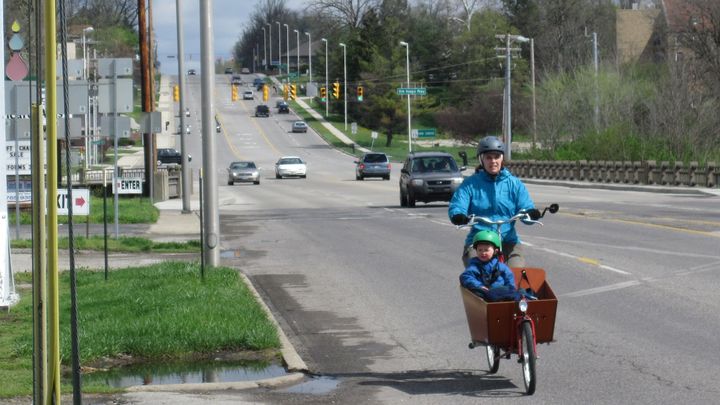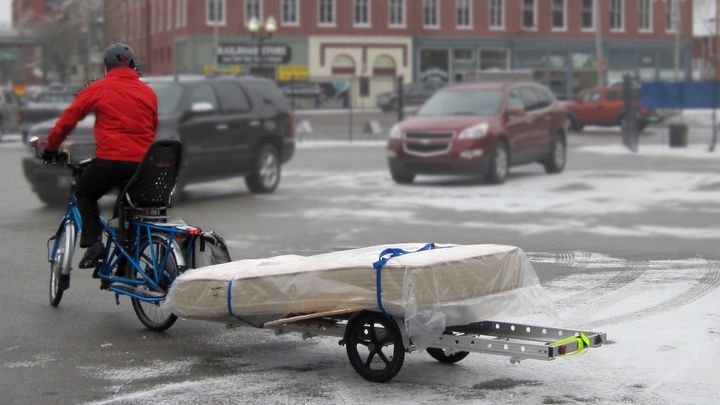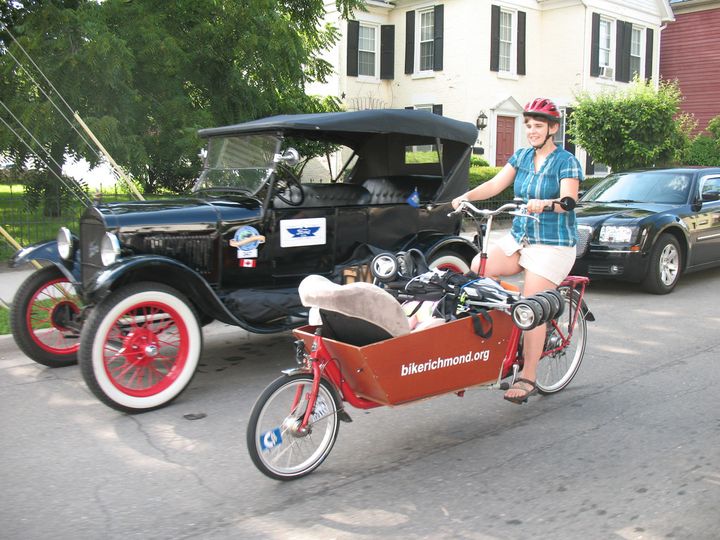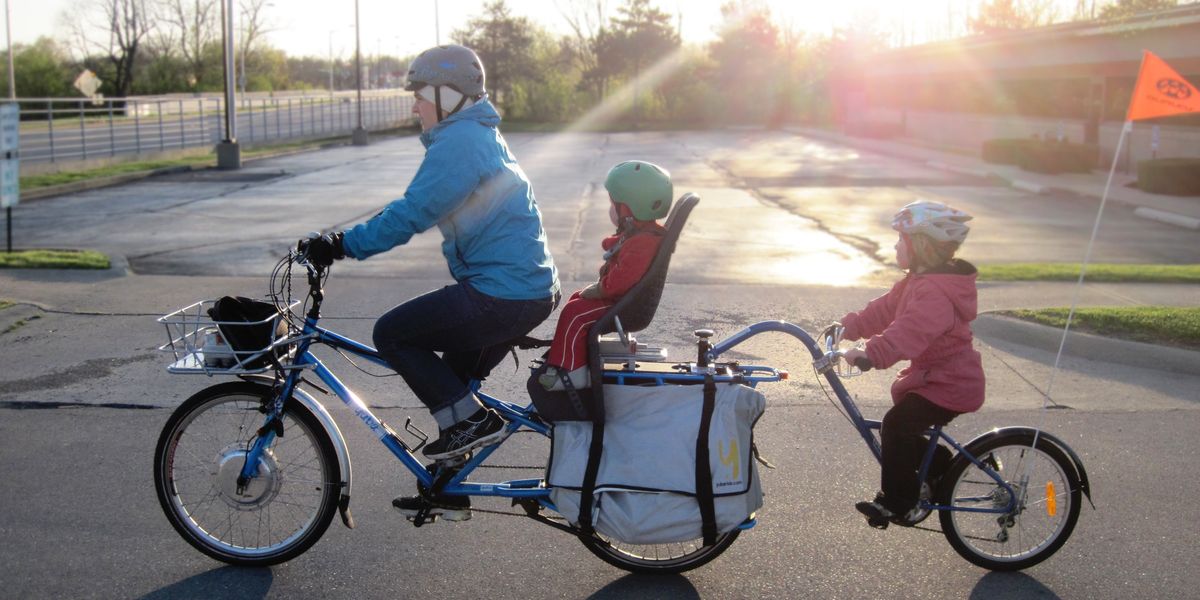
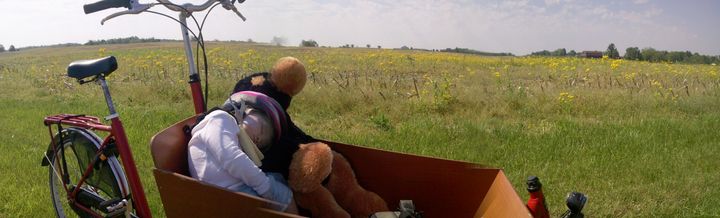
Another successful day of couch hunting.
I was unsure how I would load and unload this 225 pound waterlogged triple recliner by myself. But just at the right moments, friendly strangers showed up to help.
March 2010 Archives
I’ve recently mentioned the summary of the current federal transportation policy for bicycling and pedestrian accomodation which was signed on March 10th, 2010.
The document is accessible and relatively brief. I recommend reading through it yourself, but have included below some key highlights I believe are of interest to those advocating for improvements for bicycling in federally funded projects (which includes many state projects).
The rules of engagement are simple:
Cruise alleyways to find a suitable abandoned couch or other furniture, totaling 300 lbs or less.
Tie down acquired furniture to cargo trailer.
Proceed to city dump, choosing the flattest route possible. Ride onto the scales and get report of you total weight. Subtract the “tare weight” of the rider, bike and trailer. The final total is your score for the trip.
Steps 1 through 3 may be repeated to raise your total score for the day.
A second rider in bright attire is helpful to function as a flag vehicle, to alert traffic that there is a slow-moving 18 foot pedal-driven couchmobile up ahead.
A skillful flag vehicle may also be help to push the load up a hill, while steering with the other hand.
My total scale weight for this trip: 450. Final weight after subtracting the tare weight: About 150 lbs.
We spotted several more potential prey along the way. There will be plenty of good couch hunting this season.
Our recent Complete Streets campaign was a success in the sense that we were able to give feedback early enough in the process to make a difference.
Unfortunately, I owe this to a chance encounter in a grocery story, where someone mentioned the public hearing to me. As a leader of a local bike advocacy group, you would think it would be easy for me to be in the loop about major road projects so I could provide feedback on it. But since I’ve been in Richmond, I’ve seen two other major road projects begin construction before I even realized they were in the design phase.
If you’d like to better understand the “public involvement process” of INDOT or your state’s Department of Transportation, here’s what I’ve learned thus far.
On Friday Mayor Sally Hutton sent in the City’s official public response to INDOT’s proposed renovation of U.S 27. This phase of development starts near the Whitewater River near the Old Reid Hospitals and continues south through town. On behalf of the City, she asked INDOT for a new proposal, one based on Complete Streets principles that produce streets that work for everyone including pedestrians and cyclists. A new proposal could address serious concerns with the current proposal which would speed up traffic as it enters downtown, as well as leaving a major gap in our recommended bike route network.
The City’s response turns to be directly in line with a new policy released by the United States Department of Transportation on March 11th.
Here’s an excerpt from the new federal transportation policy:
“The DOT policy is to incorporate safe and convenient walking and bicycling facilities into transportation projects. Every transportation agency, including DOT, has the responsibility to improve conditions and opportunities for walking and bicycling and to integrate walking and bicycling into their transportation systems. Because of the numerous individual and community benefits that walking and bicycling provide — including health, safety, environmental, transportation, and quality of life — transportation agencies are encouraged to go beyond minimum standards to provide safe and convenient facilities for these modes.”
Although the City of Richmond and the Federal Government are on the same page this, we still need public support to bring this message to INDOT so they can revise the design.
Please visit this petition by March 18th to view the City’s full response to INDOT as well as signing the petition of support:
http://www.thepetitionsite.com/2/complete-streets-richmond-indiana
In my last post, I mentioned the Complete Streets concept. For a quick visual introduction I recommend leafing through the Complete Streets introduction slideshow:
Here’s a PDF of the Complete Streets intro slideshow hosted by Madison County, Indiana where a Complete Streets resolution has already been passed. You can read more about Madison County’s Complete Streets efforts if you’d like. And if you like the presentation above and what to remix it for your community, you are welcome to do so with attribution to Complete Streets. The original PowerPoint for the files are here.
If you’d like a rather technical argument for the approach, I enjoyed reading Eric Dumbaugh’s research on the safety of livable streets published in the Journal of the American Planning Association.
Complete Streets refers to the concept of designing and operating roadways with all users in mind - including bicyclists, public transportation vehicles and riders, and pedestrians of all ages and abilities.
Yesterday I was leafing through hundreds of pages of documentation about the U.S. 27 renovation through Richmond, and the importance of this hit home.
The documentation showed the many kinds of coordination and considerations that the state must go through to complete something which to some could appear to routine maintenance. During the “Early Coordination Phase” there are required considerations for hazardous waste, air quality, water quality, wildlife, historic homes, social justice, and the list goes on.
Incredibly, although the project at hand is for transportation, there were not signs of due consideration given how the road update could impact other kinds of road uses besides driving cars. A “Complete Streets” policy would require this basic consideration.
This message is a public comment on INDOT’s proposed renovations of U.S. 27 as it it passes through Richmond, a project budgeted at $21 million.
I support the City of Richmond’s response on DES#0100701 and offer the following in support of it.
What’s wrong with the current proposal
The current proposal would speed up traffic at North C Street as it enters downtown, without any consideration of the negative effects and reduced safety that higher traffic speeds have on pedestrians and cyclists.
Against current federal transportation policy, it makes no accommodations for bicycling.